
Παρουσίαση/Προβολή
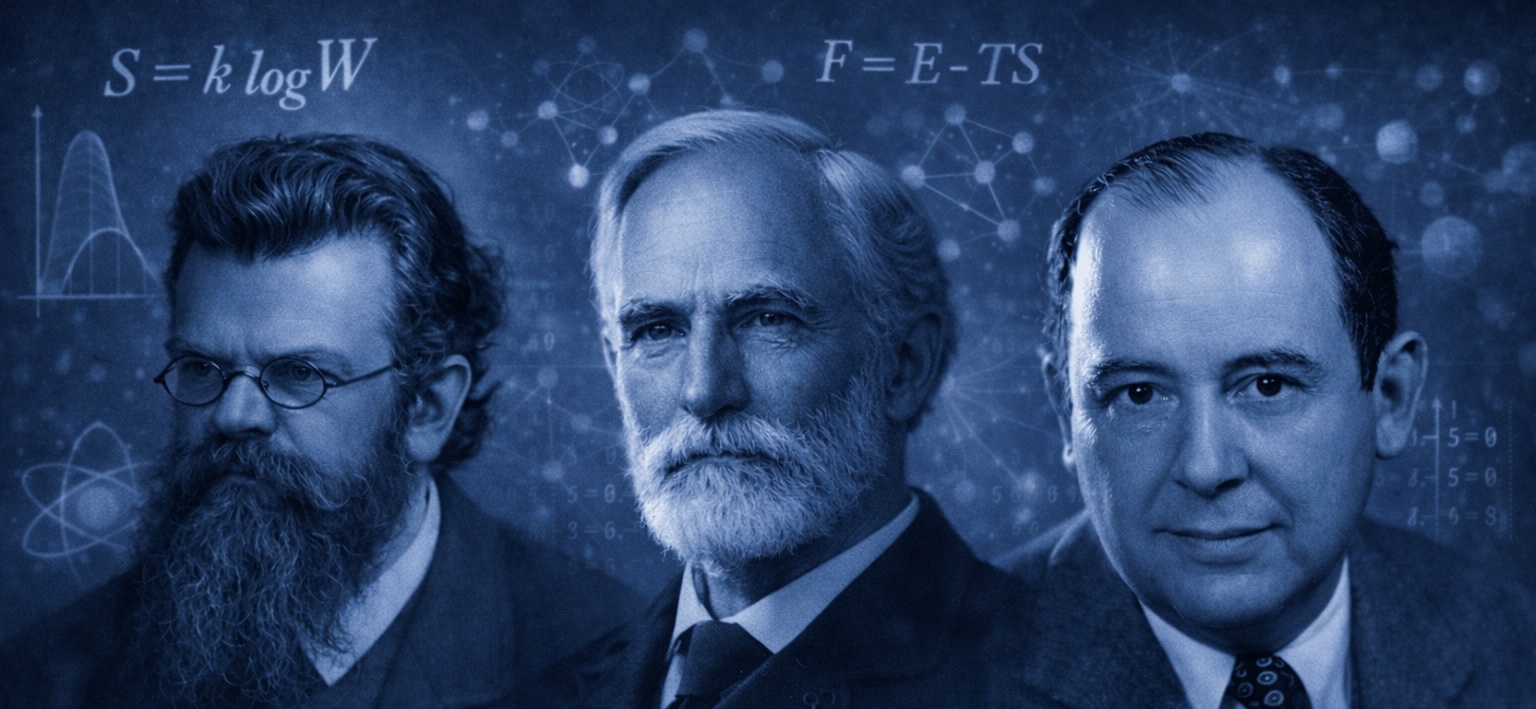
Statistical Physics
(Φ-505) - Spyros Sotiriadis
Περιγραφή Μαθήματος
Course objective:
This course is addressed to postgraduate and advanced undergraduate students. Following an introduction to the concept of statistical ensembles, the fundamental principles of statistical physics are presented, with a particular focus on the quantum mechanical formalism based on the density operator. Through the study of ideal quantum gases, applications in the theoretical description of a variety of phenomena are presented, including Bose–Einstein condensation, metal conductivity, magnetism and black body radiation.
Course details:
| Course Code | Φ-505 |
|---|---|
| Course Type | Β |
| ECTS | 6 |
| Hours | 4 |
| Term | Spring |
| Lecturer | Spyros Sotiriadis |
| Schedule |
Tuesday 17:30–19:00, 1st Floor Seminar Room
Office Hours: Thursday 16:00–17:00, Office No. 220 |
Assessment Methods:
Your final grade will be based on your homework assignments, the final written exam, and an optional project. To pass the course you need to score at least 5/10 in the final written exam.
If your grade at the final written exam is less than 5/10, your final grade will be equal to that (independently of your homework and project grades).
If instead it is at least 5/10, then:
-
if you do not submit a project, your final grade will be determined by your homework grades and your final exam grade, weighted as follows:
-
Homework: 33%
-
Written exam: 67%
-
-
if you submit a project, the weights will be as follows:
-
Homework: 20%
-
Written exam: 40%
-
Project: 40%
-
There will be 4 equally weighted homework assignments.
To fulfil the project requirements, you should submit a short report (no more than 3 pages) and give a 15min presentation, followed by a 5min "Questions and Answers" session.
Ημερομηνία δημιουργίας
Τρίτη 2 Φεβρουαρίου 2021
-
Περίγραμμα
Course Syllabus
The statistical basis of thermodynamics: Macroscopic and microscopic states. Connection between statistics and thermodynamics: the physical significance of the number of microstates. Legendre transformations and thermodynamic potentials. Extensive and intensive functions. The ideal classical gas. The entropy of mixing and Gibbs' paradox. The correct counting of microstates.
Elements of ensemble theory: The phase space of a classical system. Liouville's theorem and its consequences. The microcanonical ensemble. Examples. Quantum states and phase space.
The canonical ensemble: Equilibrium between a system and a heat bath. A system as a member of the canonical ensemble. Partition function. Energy fluctuations in the canonical ensemble: correspondence with the microcanonical ensemble. The "equal distribution" theorem of energy and the "virial" theorem.
The grand canonical ensemble: Equilibrium between a system and a heat-particle bath. A system as a member of the grand canonical ensemble. Grand partition function. Examples. Fluctuations in particle number and energy fluctuations in the grand canonical ensemble: correspondence with other ensembles.
Foundations of quantum statistics: Quantum mechanical theory of ensembles: the density operator. Statistics of different ensembles: microcanonical, canonical, and grand canonical ensembles. Systems of indistinguishable particles. The density operator in the position representation.
The theory of simple gases: An ideal quantum gas in the grand canonical ensemble.
Ideal Bose systems: Thermodynamic behaviour of an ideal Bose quantum gas. Thermodynamics of black body radiation.
Ideal Fermi systems: Thermodynamic behaviour of an ideal Fermi quantum gas. Magnetic behaviour of an ideal Fermi quantum gas: Pauli paramagnetism. The electronic gas of metals.
Βιβλιογραφία
- "Statistical Mechanics" – F. Schwabl (Springer, 2006) [course textbook]
https://link.springer.com/book/10.1007/3-540-36217-7 - "Statistical Mechanics" – K. Huang (Willey, 1963)
- "A modern Course in Statistical Physics" – L. E. Reichl (Willey, 2009)
- "Statistical Mechanics" – R. K. Pathria, P.D. Beale (Elsevier, 2011)
- "Statistical Mechanics" – F. Schwabl (Springer, 2006) [course textbook]